Wednesday, 27 April 2011

FACTORY PHOTOS: SEIPEL


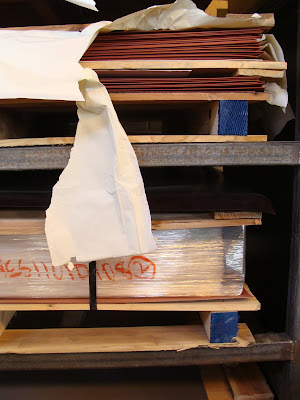
M&I found out about Seipel earlier this year; Gary Bott, creative director of Globe Trotter mentioned an old factory producing amazing leather goods. Hopefully a visit can be arranged in the near future, but for now, please enjoy these photographs that Mr Bott kindly sent our way.

Monday, 25 April 2011

NEW 'MADE IN BRITAIN' SEAL OF APPROVAL?

According to the Financial Times, a new 'Made in Britain' seal is being designed to help consumers identify products that are genuinely manufactured in the UK.

The campaign is spearheaded by Stoves, a Merseyside cooker manufacturer. The FT article states that Stoves has found '40 per cent of Britons erroneously believe that HP Sauce is still made in the UK. In fact, HP Sauce abandoned manufacturing in Birmingham after more than a century in favour of the Netherlands five years ago.'

M&I agrees that there is a need for an official 'stamp of approval' for UK goods. There is a distinct lack of promotion and protection for UK manufacturers. On a luxury level members of Savile Row created a Bespoke Association in 2004, similar to the Chambre Synidcale de la Haute Couture in Paris (founded in 1973.) If UK products are to help the country grow once again, this new logo needs proper consideration.

A quick search however, provides some concerning evidence that this new logo is destined to fail. Stoves has outsourced design to student competitions and the entries are predictably poor. The prize money of £200 indicates that design is being seen as superfluous to the process, an additional bit of polish to an ill-thought through attempt that needs consideration and consultation across a larger body of manufacturers and craftspeople.

POSTSCRIPT: Following the publication of this article we received an email from the PR for Stoves, wanting to clarify the competition. In it they explained that the logos 'will be judged by a panel of experts including Designer Magazine, a director of a creative agency and Stoves' marketing director. There will also be consultation via Facebook with the public and businesses free to put their thoughts forward. The winner will work closely with a creative agency to hone the final concept.'

Image of Retail Trading Standards Association stamp from the Sunspel archive

Sunday, 24 April 2011

WEEKLY DIGEST


A round up of the week's stories from manufacturing and design:

James Dyson on the hunt for the next great inventor, entries now open until August


And another thing...

With the Southbank Centre's Festival of Britain 60th anniversary celebrations underway you might want to have a look at a post from last September, featuring the original Festival of Britain catalogue.

Sunday, 17 April 2011

WEEKLY DIGEST

Limited edition Minis to be decked out with Rolls Royce interior touches

Reasonable Royal Wedding product alert: Stoke brewery partners with pottery to produce ceramic bottle

Life at the Dyson R&D dept sounds pretty fun


First new MG in 16 years rolls off production line at Longbridge, Birmingham

Saturday, 16 April 2011

FACTORY VISIT NO.4 : BROMPTON, BRENTFORD

M&I visited Brompton's factory in Brentford on a beautiful spring afternoon a couple of weeks ago. We were shown around by a welcoming Swedish lady and given a great insight into the working process behind the classic folding bicycles it produces.

During our turn around the factory we met Alan, an engaging gentleman who is in charge of goods and quality control. Over the course of ten minutes, Alan showed us various testing methods and told us about his love for Brompton's designs. Below is the transcription of our chat.

On Testing

"We take various measurements - how far it moves sideways, length, roll... all sorts. It takes half an hour or more on this. And on this (new machine, pictured above) it takes 4-5 minutes. All the measurements get logged by the computer. We aim to do one in fifty (tests) on each part. We’re after a very accurate measurement. On an ordinary bike, if your alignment is 2-5mm, it’s not too bad. What a big bike business will do is bend it to put it in shape. We can’t do that. We work to 0.2mm, hopefully 0.1mm. If it’s not aligned you’ll end up crabbing down the road!"

On Quality

"Quality is the issue. We have such a good crew here, everyone is about quality. Take our tubes, plenty of companies use them and it won’t matter if they’re marked a little. However, we have exacting standards - if our customer is sat on their £700 plus bike the last thing they want to see is an imperfection. We have to maintain quality at all times.

Terry, who runs this section is quality assurance (manager). Between the two of us we keep the quality of the raw materials, before paint. If a material is damaged then we will send it back. They might polish it down and this can cause us problems as it gets weaker. So we’ll test it to make sure, using weights and shifting across in 50mm, then 20mm, plotting the results on a graph. It gives the tensile strength."
On Where the Materials Come From

"We have people in Taiwan, France, Spain doing stuff (making parts for Brompton.) There’s an awful lot of parts that are absolutely ours alone, to our specification. Which is why, with our patents we fight very hard if we find there is an infringement."

On Innovation, Design and the Dangers of Complacency

"We have some young blood, as it were, with great ideas. The biggest problem in any industry is that you get complacent with what you’ve got. These people have come in over the last couple of years and said ‘why don’t we do this? Why don’t we do that?’ and the real question is ’why didn’t we think of that?!’ That’s the way it goes. In any industry, if you sit back and get complacent you might as well give your stuff to your competitors, you’ve got to keep on top all of the time."

A Work of Art and a Pleasure to Work With

"Ten years I’ve been here and I still think they’re a work of art. A great deal of that goes down to the initial quality of the work that Andrew started with when he started the business. A lot of the equipment started out with lumps of hardboard, a few screws and nails and it has all developed into this and is still expanding.

Before here I worked at a chemical firm in West Drayton. The basis there was ‘if it’s dirty, smelly and sticky we make it’. In our mixing shop where I used to work, if you stood still you’d stick to the floor. A visitor would come in and think we all needed to go to the loo as we’d be hopping foot-to-foot so we didn’t stick! Three times a year we’d get a snow plough to scrape the floor clean down to the concrete. So coming here is a pleasure!"

Annotated photos of the visit are on the M&I Facebook page

Saturday, 9 April 2011

A CHAT WITH DAVID, FACTORY MANAGER AT GLOBE TROTTER

During our visit to Globe Trotter in Broxbourne, we were introduced to David, the factory manager. He has worked for the luggage maker for over 25 years. Here is what he told us about the company:

“I was 16 when I started here, it was 1985. We’ve got lots of people who have been here 9-10 years, since we moved here (Broxbourne.) Linda’s been here 18 years. Joe's got 35 years experience; he was working for Custom Cases (an industrial case manufacturer who created designs for British Gas and BT), they bought us when we were down in Smithfield, when Henry Elkin died. We ended up down in Waltham Cross with Mossman Trunks/Custom Cases. When we moved down here we cherry picked the best from Custom Cases and brought them here. When Welwyn Handles was threatened with closure we bought them and moved them down here too."

This is the final post in our series on Globe Trotter. Coming up this week we have the write up of our visit to Brompton bicycle factory in Brentford, London.

Wednesday, 6 April 2011

INTERVIEW WITH GARY BOTT OF GLOBE TROTTER (PART THREE)

In the third part of our interview with Gary Bott we discuss the manufacturing process of Globe Trotter's luggage, the factory and its workforce, and the challenges of finding craftspeople in modern Britain.

On the Manufacturing Process

"This can’t be automated. That is quite an amazing thing. We feel we have a responsibility to protect the manufacturing side of the business. We have about 26 people working in the factory here, three of us in head office and two in the shop - that’s it for the world. We produce 200 suitcases a week, 10,000 a year. That’s it."


On the Difference Between Globe Trotter's Collections:

"Our Original series doesn’t have leather straps or leather corners, it has vulcanised straps and corners. There are five colour options. With Centenary (pictured above, Hermes edition) - it has leather straps and leather corners and is available in several colours. If we do a special or limited edition suitcases they are always centenary."

On the Joy of Longevity in a Product

"If you’re investing in a Globe Trotter case it will last you a lifetime. How many suitcases does a person need? Two, maybe three maximum. If your Globe Trotter suitcases last a lifetime you have no reason to come back to us. We’re not seasonal. We share this with the likes of Tricker’s and Brooks; once you’ve bought your Tricker’s boots or brogues you don’t tend to buy another pair. If you need to get them resoled you do so. They look better with age, as does a Globe Trotter suitcase or Brooks saddle."

On the Workforce

"We have a lady who has been with us for 40 years who stitches all the handles and straps (pictured below.) Two other ladies help her out. If we didn’t have Linda then we would be starting again. There are two guys who work on moudling the leather corners. The leather is cut into a disc shape, soaked, then pressed on a heavy duty Victorian machine, left to dry for 24 hours, pressed again, repeated. The process has to be started on a Monday. If it is only done four instead of five times it will not be as strong.

David, the factory manager, has been with the company since his teens. He’s only one of three people (the others being the quality assurance manager and production manager) who can do every single job in the factory. This is what our customers buy into."

On Finding Craftsmen

"Finding the person with the right attitude and ability is tough. Age is not so much a factor but in an ideal world you’d want a young apprentice that you could train up and would stay with a company for life. I think that culture isn’t here anymore. We’re of a generation that wants to do all sorts of things.

Geography is also a factor. Finding the right person in London is easier than finding the right person in Hertfordshire or Huddersfield for instance. Your options are limited. We can find someone locally though, most of the poeple who join Globe Trotter stay for a long time. We are always proactive in getting the factory involved, always sharing where the product ends up - whether it be Vogue, GQ or The Sunday Times Style. I think that’s great - when that factory worker is down the pub or meeting someone for the first time - they can say ‘yeah, I make those'."

Monday, 4 April 2011

INTERVIEW WITH GARY BOTT OF GLOBE TROTTER (PART TWO)

Similar to Sunspel, Globe Trotter has achieved great popularity within the Japanese market. Gary Bott told us about the brand's relationship with the country and why Globe Trotter is so popular there.

"In 2002 the Vulcanize store opened in Ayoyama in Tokyo. In 2004 we opened a Macintosh and Globe Trotter store in Burlington Arcade. The owners of Mackintosh invited me to work across both brands. Up until 2004 I hadn’t heard of Globe Trotter. Of course we had a reputation within the luggage industry... but there was very little brand awareness. Our flagship store has really helped us to educate a new audience.

In Japan they took a different view to merchandising Globe Trotter. They started using the cases as an interior design object. A piece of luggage is usually put away, up in the attic. When we launched there, everyone knew that we (the UK) had great tailoring, shoes and so forth, but they weren’t aware of our luggage. The press there are fantastic - whenever they write you up you get 12-14 pages worth of editorial compared to a page or two here, if you’re lucky.

Our distributor in Japan started Vulcanize in 2002. There’s now five of them, the latest being a three storey shop in a premises that Hugo Boss used to be in. They sell Fox Umbrellas, Turnbull & Asser, Tricker’s, Grenson, Miller Harris Perfumes, Jo Malone... all things British. But presented in the right way.

Currently there seems to be alot of brands trading on heritage - whether they genuinely have it or if they are looking to create heritage out of nothing, like Heritage Research. Nigel Cabourn is a really interesting one, over the last few years he has become incredibly popular.

I think it comes from Japan - there’s an appreciation of heritage and craftsmanship (in Japan.) There’s also the appreciation for something that is niche, hard to find."

For more pictures taken inside the Globe Trotter factory please visit the M&I Facebook page

Sunday, 3 April 2011

AN INTERVIEW WITH GARY BOTT OF GLOBE TROTTER (PART ONE)

M&I visited Globe Trotter's factory in Broxbourne, Hertfordshire in early March. Spending a few hours with Gary Bott, creative director of the luxury luggage brand, was one of the highlights of our year so far. Bott proved to be highly knowledgeable on both Globe Trotter's history and the current state of UK made brands.

After catching the train from Liverpool Street in London to Broxbourne (a journey of approximately 25 minutes) we cycled the short distance from the station to the factory, situated on a small industrial estate.

We spent the first couple of hours sat in the foyer of Globe Trotter's headquarters with Mr Bott, discussing everything from British men's design needs to the struggle of finding quality craftsmen. As we sat chatting, our conversation was punctuated by the comings and goings of customers who had dropped by to pick up repaired luggage. Each was greeted by David, the factory manager, and told about the work his team had done. This is the level of service that Globe Trotter gives its loyal customer base, and goes some way to explain why it has such a reputation.

First off we talked about what makes Globe Trotter luggage unique:

"Vulcanised fibreboard is the DNA of the Globe Trotter brand. It’s as strong as leather, as light as aluminium. Up to 80-100 years ago there were other luggage manufacturers using that material, but Globe Trotter is the only UK luggage manufacturer using vulcanised fibreboard today. There is a very old manufacturer in Sweden, called Alstermo Bruk, but they use a material which contains some plastic. We don’t use any plastic, ours is just fourteen layers of paper."

Then on to what British manufacturing stands for today:

"You might think Savile Row for tailoring, Tricker’s for footwear... then you’ve got new guys like Mr Hare coming through. Apart from tailoring and footwear what have we got? You think beautiful handbags and you think Italy. Beautiful small leather goods and you think France. Premium streetwear and denim, you might think Japan. Alot of manufacturing in this country - you do one thing well and use that as a springboard. You look at Brooks for instance, there’s a reason why people covet their saddles."

Part Two of our interview with Mr Bott will be coming soon (honest, it will be.)

Photos of our visit to Globe Trotter's factory are on the M&I Facebook page.

Wednesday, 30 March 2011

A PLUG FOR MANUFACTURE & INDUSTRY?


Well, a switch actually. Please forgive this purely aesthetic post. A friend of M&I showed us a beautiful light switch today. He sourced it from eBay and it was made in England. The packaging was an item to behold in itself. Here it is. If anyone knows the manufacturer please do leave a comment below.

Monday, 28 March 2011

AN INTERVIEW WITH NICHOLAS BROOKE OF SUNSPEL (PART TWO)

Sunspel and What it Stands For

“We think of ourselves as two things. Number one: The British jersey experts. We have developed, over the last 150 years, a number of fabrics that are unique. We are innovators in fabric development. Number two: We are manufacturers - cut and sew manufacturers in England. That is pretty rare. We're probably the last brand that manufactures cut and sew products in the UK from our own factory. There are other brands that dabble with making in the UK but they don't own the factories. The factory is not the core of the business.

When we grow the range we focus on those two things - is it a jersey and is it a cut and sew product? We do make certain items abroad, our boxer shorts for instance, but we have maintained the core here. I think a lot of other brands made a mistake in shifting all of their production abroad.”

The Creative Director

“He (J.W Anderson) loves our product. He is fundamentally a product guy at heart. He knows that what he does is about fashion but he knows that when he comes here and works with us we keep it simple. A lot of the stuff that he produces for menswear is made in the UK so there is a good synergy.”


Sunspel Mens and Sunspel Boxer

"When Peter Hill came back to run the business after the war, his elder brother was still living in Europe and he was a journalist. He then came back 5/6 years later. Then they fell out. So they decided to split the business between Sunspel Menswear and Sunspel Boxer. Peter, the guy we bought from, kept menswear and John had boxer.

Then, in the 80s, when the Levi's ad came out Boxer did really well. Because everybody started doing boxers; Marks & Spencer and so forth, the boxer side of the business effectively closed down.

When John, the brother, died, Peter bought the remaining business off of John's son. But he never really liked the boxers. I remember when we came up to speak to Peter, he said to me "what kind of underwear do you wear?" And I replied, "well boxers...briefs, a bit of both." And he responded, "Boxers. Nasty things!"

Photos of our visit are here. The informative Sunspel blog is here.

Tuesday, 22 March 2011

AN INTERVIEW WITH NICHOLAS BROOKE OF SUNSPEL (PART ONE)


Earlier this month M&I visited the Sunspel factory in Long Eaton, Derbyshire. Whilst there we met with Nicholas Brooke, the director of the company since he and business partner, Dominic Hazlehurst took over 5 and a half years ago.

Theirs is a tale of investing in a factory that was steeped in history and tradition – so much so that everything financial was still done on a ledger when they took over. We discussed the story of Sunspel, textile manufacturing in the East Midlands, and why Japan is so important to them.
Over the next few days we will be publishing some extracts of our conversation.

Taking Over

“The business started in 1860 and until 1937 the factory was in Russell St in Nottingham. I’ve known Sunspel since I was about 12 or 13, when I bought my first pair of boxer shorts. My wife's aunt is the companion of the previous owner, Peter Hill, who was part of the family who started the business. My wife’s aunt would say that ‘Peter does not want to sell the company to someone who will offshore it.’ I had been chatting to Dominic for a while about starting a business and we thought it would be a great opportunity to reestablish an old English brand.


In this room (a meeting room directly above the factory) there were four ladies who were the accounts department. Everything was done in handwritten ledgers. Then there was a final lady who had a very old computer on her desk, and as the ledgers came round she then typed them into her computer, which was wiped clean at the end of every year.

The biggest challenge has been that everything here has a massive legacy. We were careful not to chuck it all away though, because if you chuck it all away I think you lose what is ultimately the core of the brand... and then you might as well be making cheap t-shirts.

When we took over everything that was being done was very old fashioned... but we had this business with Japan which was all about slim cut coloured t-shirts."


Japan and The Japanese Consumer

“A Japanese guy went into Harrods or Selfridges... bought some underwear... and thought, ‘my, this is an amazing t-shirt. If I could do this in Japan…’ So he contacted Peter Hill to see if he could have some t-shirts made. Peter went there once... but I don't think he realised that we are in some of the best shops that you can get into.

The Japanese really understand the purity and quality of the product. What they love is; the fact that it is made in Britain, the fact that it is long staple Egyptian cotton and the fact that it is made really beautifully and it lasts. I think the UK consumer is getting closer to the way the Japanese consumer's way of thinking.”

Photos of our visit are here. The informative Sunspel blog is here.

Part two of the interview will follow shortly.